Materials scientists have developed a revolutionary technology that could make ships virtually unsinkable, using specially designed aluminum tubes that trap air even when punctured, according to research published January 30, 2026.
The innovation could transform maritime safety and has potential applications ranging from cargo vessels to naval ships and even floating structures for coastal communities threatened by rising sea levels.
The Technology
Researchers at the University of Rochester created hollow aluminum tubes with a unique surface structure that makes them extraordinarily buoyant. The tubes are etched with microscopic patterns using femtosecond laser technology, creating a surface that repels water with unprecedented effectiveness.
“Even when we drill holes through the tubes, they continue to float indefinitely,” explained Dr. Chunlei Guo, professor of optics and physics who led the research. “The surface structure traps air so effectively that water cannot penetrate, even under pressure.”
The tubes maintain buoyancy even after being submerged for months and subjected to physical abuse including punctures, crushing forces, and exposure to corrosive saltwater.
How It Works
The secret lies in the laser-etched surface patterns, which create a hierarchical structure of micro and nanoscale features. These patterns trap a thin layer of air against the metal surface—a phenomenon called a “plastron.”
“Nature inspired this design,” said Dr. Guo. “Certain insects and spiders can survive underwater by trapping air bubbles in tiny hairs on their bodies. We’ve essentially recreated this mechanism on metal surfaces.”
The plastron effect is so strong that even when tubes are punctured and filled with water, the outer surface maintains its air layer, providing enough buoyancy to keep the structure afloat.
Traditional waterproofing relies on coatings that can wear away or be damaged. The Rochester team’s approach permanently alters the metal’s surface structure, making the water-repellent properties intrinsic and durable.
Testing and Validation
Researchers subjected the aluminum tubes to rigorous testing designed to simulate real-world maritime conditions and catastrophic scenarios.
In one experiment, tubes were submerged in Lake Ontario for six months, then retrieved and tested. They maintained full buoyancy despite exposure to water pressure, temperature fluctuations, and biological fouling.
“We also tested them in saltwater, which is more corrosive than freshwater,” noted Dr. Guo. “The performance remained excellent. The surface structure resists both corrosion and biofouling—organisms that typically attach to submerged surfaces.”
Perhaps most dramatically, tubes with multiple punctures—simulating hull breaches from collisions or combat damage—continued floating with substantial load-bearing capacity.
Applications for Ships
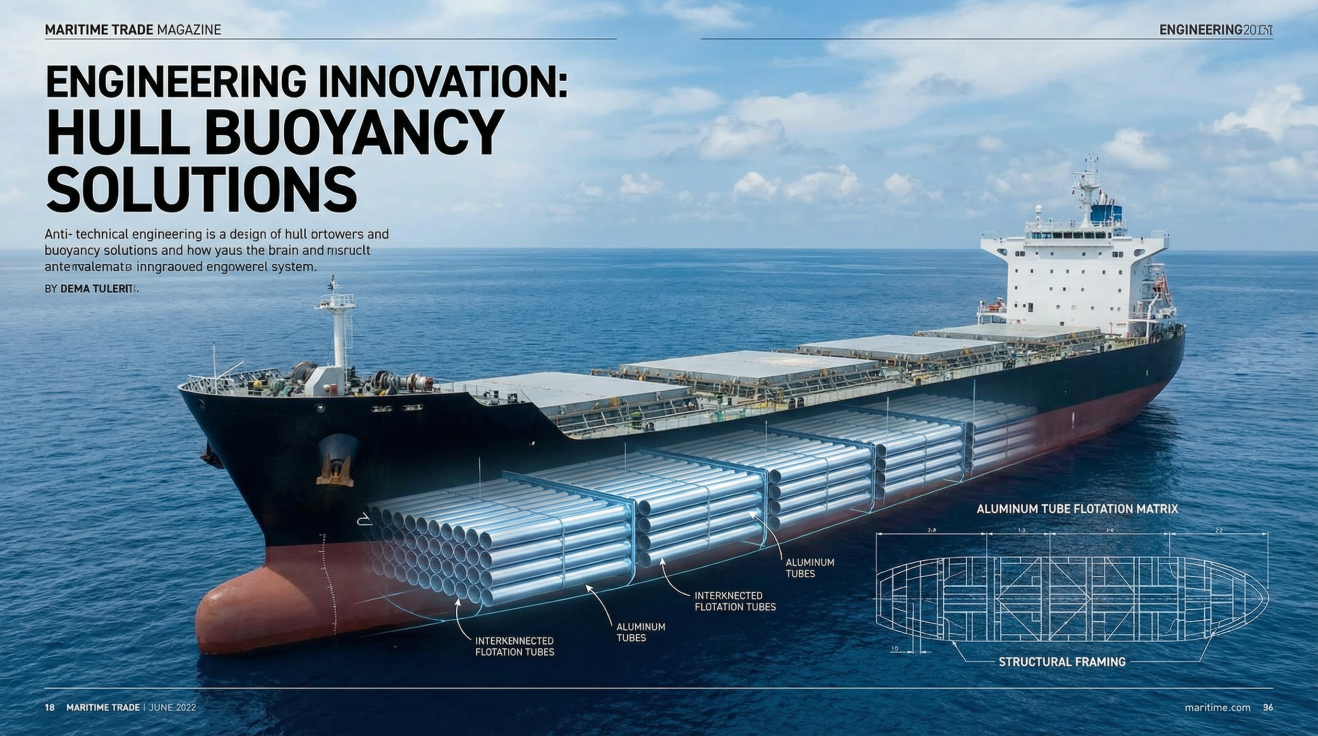
The technology could be incorporated into ship hulls in several ways. One approach involves using the treated aluminum tubes as a honeycomb structure within double-hulled vessels, providing redundant buoyancy even if the outer hull is compromised.
“Imagine a cargo ship with a hull breach,” explained Dr. Patricia Morrison, naval architect at MIT who reviewed the research. “Normally, flooding would cause the ship to sink or list dangerously. With this technology integrated into the hull structure, the ship would maintain buoyancy and stability even with significant damage.”
The tubes could also be used in life-saving equipment, creating life rafts and flotation devices that remain functional even if punctured or damaged during emergencies.
For naval vessels, the technology offers potential protection against torpedo attacks and mine strikes—scenarios where rapid flooding of compartments can sink ships within minutes.
Manufacturing Considerations
Creating the laser-etched surface patterns currently requires sophisticated equipment and is time-intensive for large surfaces. However, Dr. Guo’s team is developing scaled-up manufacturing processes.
“We’ve demonstrated the principle at laboratory scale,” said Dr. Guo. “The next phase involves industrial partners to develop cost-effective mass production methods. We believe this is achievable within three to five years.”
The aluminum tubes themselves are lightweight and relatively inexpensive. The primary cost factor is the laser processing, but researchers are optimizing the etching patterns to reduce processing time while maintaining performance.
Beyond Ships
The technology has applications extending far beyond maritime vessels. Researchers envision using the tubes to create floating platforms for various purposes:
– Emergency flood barriers that can be rapidly deployed during hurricanes or storm surges
– Floating solar panel arrays for renewable energy generation
– Aquaculture facilities that can withstand harsh ocean conditions
– Floating buildings and infrastructure for coastal communities facing sea level rise
“As climate change drives sea levels higher, coastal cities will need innovative solutions,” noted Dr. Morrison. “Floating structures built with this technology could provide resilient housing and infrastructure that rises with the water rather than being inundated.”
Environmental Benefits
The technology could reduce maritime environmental disasters. Ships that remain afloat even when damaged are less likely to spill cargo, fuel, or hazardous materials into the ocean.
“Shipwrecks and sinkings cause significant environmental damage,” said Dr. Elena Vasquez, marine ecologist at the Scripps Institution of Oceanography. “Technology that prevents ships from sinking would reduce oil spills, cargo losses, and the introduction of pollutants to marine ecosystems.”
The aluminum tubes are also fully recyclable, and the laser etching process doesn’t involve toxic chemicals, making the technology environmentally friendly to produce.
Historical Context
The quest for unsinkable ships has a long history, famously exemplified by the Titanic’s tragic sinking in 1912 despite being marketed as unsinkable. Modern ships incorporate numerous safety features including watertight compartments, but catastrophic damage can still cause sinking.
“No technology can make ships completely immune to sinking under all circumstances,” cautioned Dr. Morrison. “But this represents a genuine leap forward in maritime safety, potentially preventing many of the sinkings that occur due to collisions, groundings, and hull failures.”
Next Steps
The University of Rochester team is collaborating with shipbuilders and the U.S. Navy to develop prototype applications. Initial focus will be on smaller vessels and specific ship components before scaling to large commercial vessels.
“We’re in discussions with several maritime industry partners,” said Dr. Guo. “There’s strong interest in testing this technology in real-world conditions. We expect to see the first practical applications within the next few years.”
The research was funded by the U.S. Office of Naval Research and the National Science Foundation. The team has filed multiple patents covering the surface treatment process and its applications.
As the technology moves from laboratory to practical implementation, it could mark a new era in maritime safety—one where ships that “cannot sink” move from marketing myth to engineering reality.