
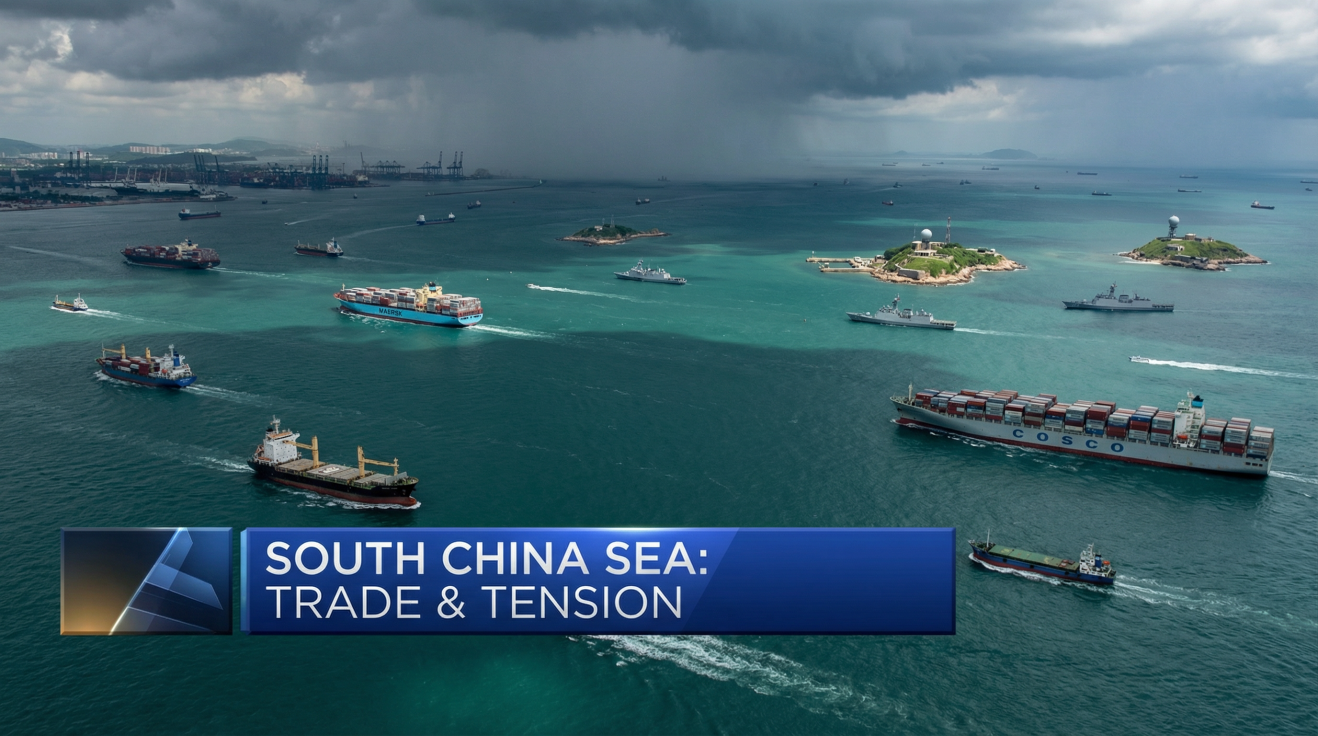
The escalating tensions in the South China Sea have moved beyond military posturing and diplomatic protests to threaten the arteries of global commerce. With an estimated $7.4 trillion in annual trade flowing through the South China Sea and adjacent East China Sea, the strategic waterway has become a pressure point where geopolitical rivalry intersects with economic vulnerability. As the United States and Philippines conduct joint military exercises at disputed features like Scarborough Shoal, and China responds with increasingly assertive countermeasures, the world’s most critical shipping lanes face disruption risks that could reshape global supply chains and impose hundreds of billions of dollars in costs on the international economy.
The Strategic Chokepoint: Trade Volumes at Risk
The South China Sea functions as the central nervous system of Asian trade and a vital corridor for global commerce. According to the Center for Strategic and International Studies, approximately $3.4 trillion in trade passed through the South China Sea in 2016, a figure that has grown substantially in subsequent years as Asian economies expanded and supply chains deepened their regional integration. When combined with the adjacent East China Sea, the total trade value reaches approximately $7.4 trillion annually, representing a substantial portion of global merchandise trade.
These are not abstract figures detached from real-world consequences. The South China Sea shipping lanes carry energy resources from the Middle East to energy-hungry Asian economies, manufactured goods from Chinese and Southeast Asian factories to global markets, and agricultural commodities that feed billions of people. Any significant disruption to these flows would cascade through supply chains, raising costs for consumers, squeezing profit margins for businesses, and potentially triggering inflationary pressures in economies already grappling with monetary policy challenges.
A 2025 study published in PMC estimated that the expected value of trade disrupted at maritime chokepoints globally totals approximately $192 billion annually, with geopolitical risk at strategic passages like the South China Sea accounting for a substantial share of this figure. The concentration of trade through a relatively small number of maritime passages creates systemic vulnerabilities, where localized tensions can generate global economic shocks.
Freight Rate Volatility and Supply Chain Strain
The economic impact of South China Sea tensions extends beyond hypothetical disruption scenarios to measurable effects already visible in freight markets and supply chain operations. From January to July 2024, freight rates on key Asian routes more than doubled, with the Shanghai-South America route reaching $9,026 per twenty-foot equivalent unit (TEU), up from approximately $4,000 in previous periods. While multiple factors contribute to freight rate volatility—including port congestion, vessel availability, and fuel costs—geopolitical uncertainty in critical shipping lanes adds a risk premium that shippers must absorb or pass on to customers.
These elevated freight costs strain global supply chains that were already tested by the COVID-19 pandemic and subsequent disruptions. The United Nations Conference on Trade and Development reported in October 2024 that high freight rates were placing particular pressure on vulnerable economies with limited bargaining power in shipping markets and heavy dependence on imported goods. For small businesses operating on thin margins, the combination of higher transportation costs, shipment delays, and uncertainty about future access to shipping routes creates an environment where planning becomes difficult and profitability suffers.
The economic strain is not distributed evenly across regions or sectors. Asian nations find themselves caught between the intensifying trade and geopolitical tensions between Beijing and Washington, even as countries like the Philippines attempt to navigate a path that preserves economic ties with China while strengthening security cooperation with the United States. The Philippines, despite its front-line position in South China Sea disputes, is considered less exposed to trade war fallout than some other Asian economies due to its economic structure, but the country still faces costs from maritime tensions that affect shipping insurance rates, investor confidence, and tourism flows.
China’s Economic Calculus and Trade Surplus Dynamics
Paradoxically, even as South China Sea tensions escalate, China’s trade performance has remained robust, with the country’s trade surplus reaching a record $1.2 trillion in 2025. This reflects China’s success in diversifying export markets, leveraging manufacturing capacity in other Asian countries, and maintaining competitiveness despite tariffs and geopolitical headwinds. However, this aggregate trade surplus masks underlying vulnerabilities in China’s economic model, including a stagnating domestic economy, youth unemployment, and societal discontent that create pressure on Beijing to maintain export-driven growth.
China’s foreign policy calculus in the South China Sea is shaped by domestic economic imperatives as much as strategic ambitions. Maintaining control over disputed features and asserting sovereignty claims serves multiple purposes: projecting power, securing access to potential energy resources, protecting fishing grounds that support coastal communities, and demonstrating resolve to domestic audiences. Yet these same actions generate friction with neighboring countries and the United States, creating risks of miscalculation that could disrupt the very trade flows on which China’s economy depends.
The $5.3 trillion question, as one analysis framed it, is whether South China Sea tensions will fundamentally rewrite global trade rules or whether economic interdependence will ultimately constrain military escalation. China’s leadership appears to be betting that it can assert control over disputed waters without triggering a conflict that would sever the economic relationships that underpin its prosperity, while the United States and its regional partners calculate that demonstrating resolve through military exercises and security cooperation will deter Chinese aggression without crossing thresholds that lead to armed conflict.
Infrastructure Vulnerabilities and Cascading Risks
Beyond the immediate risks to shipping, South China Sea tensions threaten critical infrastructure that enables trade flows. Submarine cables carrying internet and financial data crisscross the seabed, port facilities in disputed areas face potential disruption, and energy infrastructure—including offshore oil and gas platforms—could become targets or collateral damage in any escalation. The interconnected nature of modern supply chains means that disruption at one node can cascade through the system, creating bottlenecks and delays that multiply costs far beyond the initial point of failure.
Territorial disputes in the South China Sea also create regulatory uncertainty that complicates business planning. Companies operating in disputed waters face questions about which country’s laws apply, whether permits issued by one claimant will be recognized by others, and whether investments in infrastructure or resource extraction will be secure over the long term. This legal ambiguity discourages investment and creates inefficiencies as businesses hedge against multiple scenarios.
The systematic impacts of disruptions at maritime chokepoints extend to energy security, food security, and the availability of critical inputs for manufacturing. Japan, South Korea, and Taiwan—all major economies heavily dependent on imported energy and raw materials—are particularly vulnerable to South China Sea disruptions. Any sustained interference with shipping lanes would force these countries to seek alternative routes that add time and cost, or to draw down strategic reserves that provide only temporary buffers.
Regional Responses and Economic Hedging Strategies
Southeast Asian nations are pursuing economic hedging strategies to reduce their vulnerability to South China Sea disruptions. These include diversifying trade partners, investing in alternative transportation infrastructure such as rail links that bypass maritime chokepoints, and building strategic reserves of critical commodities. The Association of Southeast Asian Nations (ASEAN) has sought to maintain a unified position that balances economic engagement with China against security concerns, though member states’ individual interests sometimes diverge.
The economic dimension of South China Sea tensions is forcing governments and businesses to confront trade-offs between efficiency and resilience. For decades, global supply chains optimized for cost and speed, concentrating production in specific locations and relying on just-in-time delivery that minimized inventory costs. The combination of pandemic disruptions, geopolitical tensions, and climate-related shocks has exposed the fragility of these arrangements, prompting a reevaluation that prioritizes redundancy and geographic diversification even at the expense of short-term efficiency gains.
This shift has economic implications that extend beyond the South China Sea. Companies are nearshoring or friendshoring production, moving manufacturing closer to end markets or to countries perceived as politically aligned. These adjustments require capital investment, create transition costs, and may result in higher production expenses that ultimately flow through to consumer prices. The economic geography of global trade is being redrawn in ways that reflect geopolitical realities as much as comparative advantage.
The Insurance and Risk Premium Dimension
Maritime insurance markets provide a real-time barometer of perceived risks in the South China Sea. Insurers adjust premiums based on assessments of conflict probability, piracy risks, and the likelihood of vessel seizure or damage. As tensions have escalated, insurance costs for ships transiting disputed waters have risen, adding another layer of expense to supply chains. For shipowners and cargo interests, these higher premiums represent a direct cost of geopolitical uncertainty that must be factored into route planning and pricing decisions.
The insurance dimension also creates feedback loops that can amplify economic impacts. If insurers deem certain routes too risky or refuse coverage altogether, ships may be forced to take longer alternative paths that add days to transit times and increase fuel consumption. These delays ripple through supply chains, affecting inventory management, production schedules, and delivery commitments. In extreme scenarios, the unavailability of insurance could effectively close shipping lanes even in the absence of physical blockades or military action.
Long-term Economic Realignment and Strategic Decoupling
The economic fallout from South China Sea tensions is accelerating broader trends toward strategic decoupling between the United States and China. While complete economic separation remains impractical given the depth of integration built over decades, both countries are pursuing policies that reduce dependencies in critical sectors. The United States is restricting Chinese access to advanced technologies, particularly in semiconductors and artificial intelligence, while China is investing heavily in domestic substitutes for imported components and technologies.
This partial decoupling carries economic costs for both sides. American companies lose access to the Chinese market and face higher production costs as they relocate supply chains. Chinese firms confront barriers to accessing cutting-edge technologies and must invest in developing capabilities that could have been imported more cheaply. The global economy as a whole loses efficiency gains from specialization and faces the prospect of duplicative investments as parallel supply chains emerge to serve different geopolitical blocs.
The South China Sea has become a focal point where these broader economic and strategic tensions play out in concrete form. Control over shipping lanes translates into leverage over trade flows, making the waterway a arena where economic interdependence and geopolitical competition intersect. The outcome of this competition will shape not only regional security dynamics but also the structure of the global economy for decades to come.
Implications for Global Economic Governance
The economic dimensions of South China Sea tensions raise questions about the adequacy of existing mechanisms for managing trade disputes and maritime conflicts. The World Trade Organization provides frameworks for resolving commercial disagreements, while the United Nations Convention on the Law of the Sea establishes rules for maritime boundaries and navigation rights. Yet these institutions have proven unable to prevent or resolve the South China Sea disputes, as major powers pursue interests that transcend legal frameworks.
China’s rejection of the 2016 arbitral tribunal ruling that invalidated its expansive maritime claims exemplifies the limits of international law when states perceive core interests at stake. The United States’ freedom of navigation operations assert legal principles but do not compel China to alter its behavior. This gap between legal norms and political realities creates uncertainty that markets struggle to price and businesses find difficult to navigate.
The challenge for global economic governance is to develop mechanisms that can manage the intersection of economic interdependence and strategic competition without either enabling coercion or triggering catastrophic conflict. This may require new institutions or reformed existing ones that can address the reality that trade and security are increasingly inseparable in key regions like the South China Sea.
Conclusion: Navigating Economic Uncertainty
The economic fallout from South China Sea tensions represents a test case for how the international community manages the collision between globalization’s legacy of economic integration and the return of great power competition. The $7.4 trillion in annual trade flowing through these contested waters is not merely an economic statistic but a measure of the interdependence that both constrains conflict and creates vulnerabilities that adversaries can exploit.
For businesses, the imperative is to build resilience through diversification, contingency planning, and investments in alternative supply chains that reduce exposure to single points of failure. For governments, the challenge is to balance the economic benefits of open trade with the security imperatives of protecting national interests and supporting allies. For the international system, the South China Sea tensions highlight the need for frameworks that can accommodate strategic competition while preserving the economic cooperation that has lifted billions out of poverty and created unprecedented prosperity.
The economic dimension of South China Sea tensions will not be resolved through military exercises or diplomatic protests alone. It requires sustained engagement to build confidence, establish crisis management mechanisms, and create economic incentives that align with peaceful resolution of disputes. The alternative—a descent into economic fragmentation and potential military conflict—would impose costs that dwarf the trade flows currently at risk, making the pursuit of stability not merely a strategic preference but an economic necessity.