The war in Ukraine has entered its fourth year with no end in sight, as diplomatic efforts to negotiate a settlement collide with Russia’s continued insistence on maximalist demands that would effectively nullify Ukrainian sovereignty and Western security guarantees designed to deter future Russian aggression. US Secretary of State Marco Rubio’s confirmation on January 28, 2026, that the United States and Ukraine have finalized security guarantees represents a significant milestone in efforts to provide Kyiv with credible assurances of Western support, but Russia’s immediate rejection of these guarantees underscores the fundamental incompatibility between Ukrainian and Russian visions for ending the conflict.
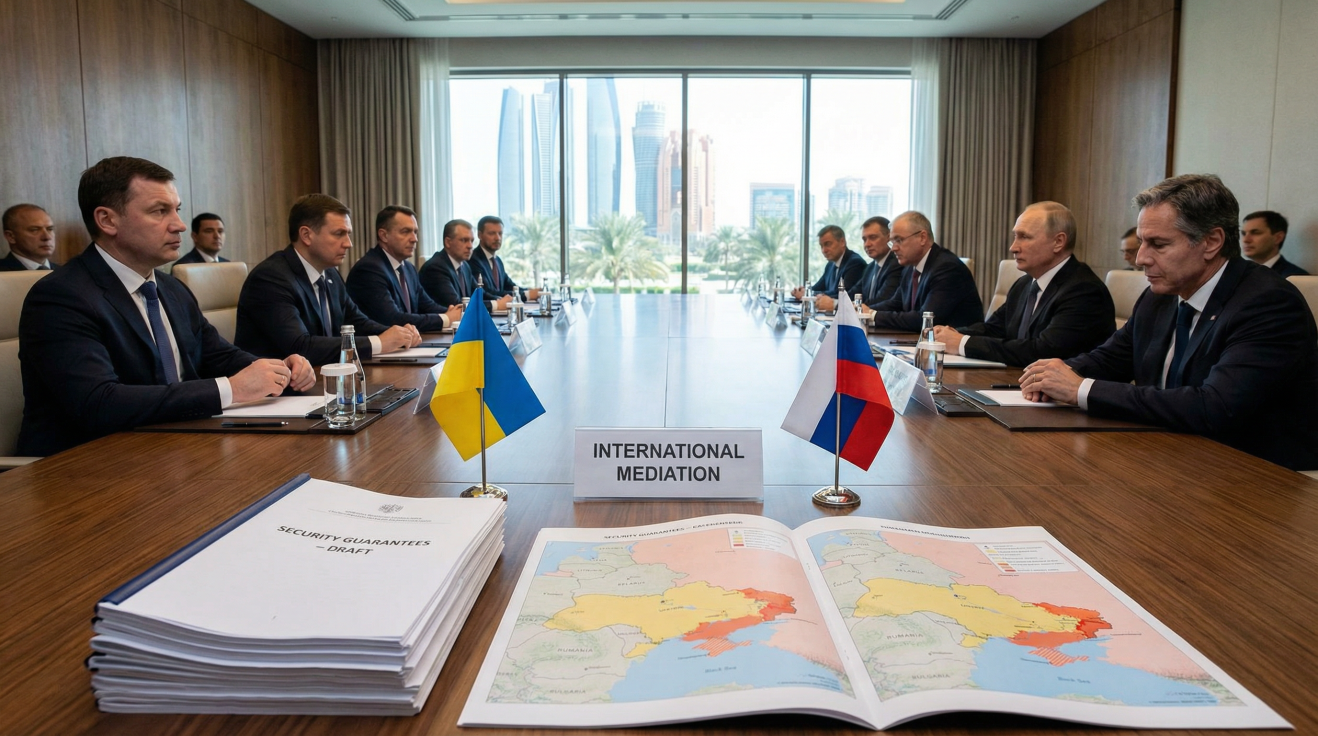
Rubio stated that it “could [be] argue[d]” that the United States and Ukraine have finalized security guarantees, noting that the United States will play a “key role” in these arrangements and that there is a “general consensus” on the possible deployment of a small contingent of European troops to Ukraine with US support. The Secretary of State also indicated that the United States may send a representative to the planned Ukrainian-Russian negotiations in Abu Dhabi scheduled for February 1, 2026, though he clarified that US Special Envoy to the Middle East Steve Witkoff and former Senior Advisor to the US President Jared Kushner will not participate.
The finalization of security guarantees represents the culmination of months of negotiations between the United States, European allies, and Ukraine about how to provide Kyiv with credible assurances that would deter future Russian aggression even if a negotiated settlement freezes the current front lines without resolving the underlying territorial disputes. The challenge has been to design guarantees that are sufficiently robust to convince both Ukraine and Russia that renewed aggression would trigger a decisive Western response, while avoiding commitments that would automatically draw NATO into direct conflict with Russia or that Western publics and legislatures would be unwilling to sustain over the long term.
The proposed deployment of a small European troop contingent with US support appears designed to provide a tripwire presence that would make any future Russian offensive against Ukraine also an attack on European forces, thereby activating alliance commitments and making Western intervention more politically feasible. However, the effectiveness of such a deployment would depend on its size, location, rules of engagement, and the clarity of the political commitments backing it—all details that remain to be fully specified and that Russia will undoubtedly test through various forms of pressure and provocation.
Russia’s response to the finalized security guarantees was swift and unequivocal. Foreign Minister Sergey Lavrov, in an interview with Turkish media outlets on January 29, rejected the terms of Western security guarantees by falsely dismissing them as an attempt to protect the “illegitimate” Ukrainian government and reiterating Russian commitment to the security guarantees framework Russia presented during the 2022 Istanbul negotiations.
The 2022 Istanbul negotiations, which occurred in the early months of the war when Russian forces were still threatening Kyiv, produced a draft agreement that amounted to Ukraine’s full capitulation to Russia. The draft imposed harsh limits on the size and activity of Ukraine’s military while imposing no such restrictions on Russia, and it provided Russia with veto power over the ability of states guaranteeing Ukraine’s security to respond to future armed conflict in Ukraine. In essence, the Istanbul framework would have left Ukraine defenseless against future Russian aggression while preventing Western nations from providing meaningful assistance, creating conditions for Russia to complete its conquest of Ukraine at a time of its choosing.
Lavrov’s invocation of the Istanbul framework signals that Russia’s negotiating position has not moderated despite nearly four years of war and hundreds of thousands of casualties. The Foreign Minister also reiterated the Kremlin’s commitment to the demands that Russian President Vladimir Putin laid out in his June 2024 speech to the Russian Ministry of Foreign Affairs, in which Putin demanded the capitulation of both Ukraine and NATO to Russia’s original war aims, including recognition of Russian sovereignty over all territories it has illegally annexed, severe restrictions on Ukraine’s military capabilities and foreign policy orientation, and effective veto power over NATO expansion and military deployments in Eastern Europe.
Lavrov falsely claimed that the current Ukrainian government poses a persistent threat to Russian security, echoing the Kremlin’s longstanding narrative that the 2014 Euromaidan revolution that ousted pro-Russian President Viktor Yanukovych was a Western-backed coup that installed an illegitimate and hostile regime in Kyiv. This narrative serves to justify Russia’s aggression as defensive in nature and to delegitimize any Ukrainian government that does not subordinate itself to Russian interests, effectively denying Ukraine’s right to exist as an independent state with its own foreign policy choices.
Other Russian officials have reinforced the Kremlin’s hardline stance. Chechen Republic Head Ramzan Kadyrov, a close Putin ally known for his extreme rhetoric and brutal suppression of dissent in Chechnya, asserted on January 29 that the Kremlin should not negotiate with Ukraine and should instead continue the war until Russia achieves its objectives. Russian Federation Council and State Duma deputies, who often act as amplifiers for the Kremlin’s rhetorical lines, reiterated Russia’s commitment to advancing on the frontline and made false claims that Ukraine has no right to the territories that Russia has illegally annexed, calling for Ukraine to capitulate to Russia to make negotiations easier.
The Kremlin’s continued refusal of meaningful security guarantees for Ukraine suggests that it remains committed to what analysts have termed Putin’s “theory of victory”—the belief that Russia can win in Ukraine by outlasting Ukraine’s ability to fight and the West’s desire to support Ukraine. This theory assumes that Western publics will eventually tire of the economic costs and geopolitical risks associated with supporting Ukraine, that political changes in Western capitals will bring to power leaders less committed to Ukrainian sovereignty, and that Russia’s willingness to sustain casualties and economic hardship gives it an advantage in a war of attrition.
The military situation on the ground provides some support for this theory, though not enough to guarantee Russian success. From late February 2024 to early January 2026, Russian forces advanced just under 50 kilometers, at an average pace of only about 70 meters per day, according to analysis by the Center for Strategic and International Studies. This grinding, incremental progress has come at enormous cost in casualties and equipment, but it has nevertheless allowed Russia to expand its control over additional Ukrainian territory and to maintain pressure on Ukrainian forces that must defend a long front line with limited reserves.
Russia launched at least 736 drones and 23 missiles against Ukraine in the period of January 22-28, 2026, according to tracking by Russia Matters, demonstrating Moscow’s continued ability to strike targets throughout Ukraine despite years of Western military assistance and Ukrainian efforts to develop air defense capabilities. These strikes have targeted energy infrastructure, military facilities, and civilian areas, aiming to degrade Ukraine’s warfighting capacity, undermine morale, and create pressure on the Ukrainian government to accept a settlement on Russian terms.
Ukrainian President Volodymyr Zelenskyy has stated that Ukraine needs to inflict 50,000 Russian casualties per month to win the war, a figure that reflects the scale of Russia’s mobilization and its willingness to sustain losses that would be politically unsustainable in most Western democracies. Whether Ukraine can achieve and sustain such casualty rates with the military assistance it is receiving remains uncertain, as does the question of how long Russia can continue to replace its losses through mobilization and recruitment without triggering domestic political instability.
The exchange of killed-in-action servicemembers between Ukraine and Russia on January 29, 2026, represents one of the few areas of humanitarian cooperation between the warring parties, enabling families to bury their loved ones as the conflict continues. Such exchanges underscore the human cost of the war while doing little to address the underlying political and territorial disputes that perpetuate the violence.
Russian forces have recently adopted new tactics designed to extend the battlefield deeper into Ukrainian-controlled territory. Ukrainian Ministry of Defense advisor Serhiy “Flash” Beskrestnov reported on January 29 that Russian forces have begun conducting several strikes per day using Molniya fixed-wing first-person view drones equipped with Starlink satellite terminals against Ukrainian vehicles traveling along the E-50 Pokrovsk-Pavlohrad highway, roughly 50 kilometers from the frontline.
Ukrainian military sources told Ukrainian broadcaster Suspilne that Russian forces began employing Molniya drones in strikes against a section of the E-50 highway running between Troitske (approximately 35 kilometers behind the frontline) and Pavlohrad (approximately 78 kilometers behind the frontline) roughly two weeks ago, in mid-January 2026. This represents a form of battlefield air interdiction at operational depth (about 25 to 100 or more kilometers from the frontline), complicating Ukrainian logistics and force movements in areas previously considered relatively secure from direct attack.
The use of Starlink terminals on Russian drones is particularly significant, as it suggests that Russia has found ways to access the satellite internet service despite efforts by SpaceX and Western governments to prevent Russian military use of the system. If Russia can reliably employ Starlink-equipped drones at scale, it would significantly enhance Russian ability to conduct precision strikes at extended ranges, potentially offsetting some of Ukraine’s advantages in intelligence and targeting.
The diplomatic landscape surrounding the war has become increasingly complex as various actors pursue negotiations that may or may not lead to a sustainable settlement. The United States is reportedly pushing Ukraine to cede the remainder of Donetsk Oblast to Russia in exchange for US security guarantees, according to analysis by the Institute for the Study of War, reflecting growing pressure on Kyiv to accept territorial losses in exchange for commitments that would deter future Russian aggression.
This reported American position represents a significant shift from earlier insistence that Ukraine must recover all its territory, including Crimea, and it reflects a pragmatic assessment that the current military situation makes full territorial restoration unlikely in the near term. However, any Ukrainian agreement to cede territory would be politically fraught, as it would require Zelenskyy to abandon the principle that Ukraine will not negotiate away its sovereignty and to convince the Ukrainian public that security guarantees provide sufficient compensation for permanent loss of Ukrainian land.
Public opinion polling suggests that Ukrainians might be willing to accept such a trade-off under certain conditions. According to data cited by Russia Matters, 72% of Ukrainians would approve a peace plan that freezes the front lines with security guarantees and without recognizing Russian annexations, while 66% of Russians support peace negotiations. These figures suggest that war weariness exists on both sides, but they also reveal the gap between what each side considers an acceptable outcome—Ukrainians want security guarantees that allow them to maintain sovereignty and eventually recover lost territory, while Russians want recognition of territorial gains and limits on Ukraine’s ability to align with the West.
The upcoming negotiations in Abu Dhabi on February 1, 2026, will provide an important test of whether the diplomatic process can produce meaningful progress toward a settlement or whether the fundamental incompatibility between Ukrainian and Russian positions makes continued warfare inevitable. The fact that the United States may send a representative suggests that Washington sees value in engaging with the process, even if expectations for breakthrough are low.
However, Russia’s maximalist demands and rejection of Western security guarantees suggest that Moscow sees little reason to compromise as long as it believes time is on its side. The Kremlin calculates that it can continue to make incremental territorial gains, that Western support for Ukraine will eventually weaken, and that Russia’s greater willingness to sustain casualties and economic hardship gives it an advantage in a prolonged conflict. Unless these calculations change—either through Ukrainian military successes that convince Moscow that victory is unattainable, or through Western commitments that persuade the Kremlin that continued aggression will trigger responses that outweigh any potential gains—the war is likely to continue indefinitely.
The finalization of US-Ukrainian security guarantees represents an attempt to change Russia’s calculus by demonstrating that Western support for Ukraine will not collapse and that any future Russian aggression will face a more robust response than the initial invasion did. The effectiveness of these guarantees will depend on their specific terms, the credibility of the commitments backing them, and Russia’s assessment of whether the West would actually follow through on its promises in the event of renewed conflict.
The broader implications of the Ukraine war extend far beyond the immediate battlefield. The conflict has fundamentally altered European security architecture, prompting NATO expansion to include Finland and Sweden, massive increases in defense spending by European nations, and a recognition that the post-Cold War peace dividend was premature. The war has also tested the resilience of the Western alliance system, with some nations demonstrating strong commitment to supporting Ukraine while others have been more hesitant, creating tensions that Russia has sought to exploit.
For Ukraine, the war has been catastrophic in human and economic terms, with hundreds of thousands of casualties, millions of refugees and internally displaced persons, massive destruction of infrastructure and housing, and the loss of significant territory including some of the country’s most industrialized regions. Even if a settlement is reached that preserves Ukrainian sovereignty and provides security guarantees, the country will face decades of reconstruction and the challenge of reintegrating territories that have been under Russian occupation and subjected to intense Russification efforts.
For Russia, the war has resulted in international isolation, severe economic sanctions, the loss of key export markets, and casualties that may eventually threaten domestic political stability. However, Putin has successfully suppressed dissent and maintained control over Russian media and political institutions, preventing the emergence of an organized opposition that could challenge his rule or force a change in policy. The Kremlin’s ability to sustain the war effort despite these costs suggests that Russia is prepared for a prolonged conflict if necessary to achieve its objectives.
The international community faces difficult choices about how to respond to the Ukraine war and what precedents it sets for future conflicts. Allowing Russia to retain territory seized through aggression would undermine the principle that borders cannot be changed by force, potentially encouraging other revisionist powers to pursue their own territorial ambitions. However, continuing to support Ukraine indefinitely carries economic costs and risks of escalation that many nations are reluctant to bear, particularly as other global challenges compete for attention and resources.
The path forward remains uncertain, but several principles should guide policy. First, any settlement must be based on Ukraine’s consent and must not reward aggression by allowing Russia to achieve through war what it could not achieve through peaceful means. Second, security guarantees for Ukraine must be credible and robust enough to deter future Russian aggression, which requires clear commitments backed by military capabilities and political will. Third, the international community must maintain pressure on Russia through sanctions and diplomatic isolation until it demonstrates a genuine commitment to peaceful resolution of disputes and respect for international law.
The finalization of US-Ukrainian security guarantees represents progress toward these goals, but much work remains to translate general principles into specific commitments that can withstand the test of implementation. The upcoming negotiations in Abu Dhabi will reveal whether Russia is prepared to engage seriously with proposals for ending the war or whether Moscow remains committed to pursuing its maximalist objectives regardless of the cost. The answer to that question will determine whether 2026 brings progress toward peace or another year of grinding attrition and human suffering.