The South China Sea has emerged as one of the world’s most dangerous flashpoints, where competing territorial claims, great power rivalry, and alliance dynamics converge in waters critical to global trade and regional security. The latest joint military exercises between the United States and the Philippines at the disputed Scarborough Shoal represent a significant escalation in the strategic competition between Washington and Beijing, with profound implications for the stability of the Indo-Pacific region and the future of the rules-based international order.
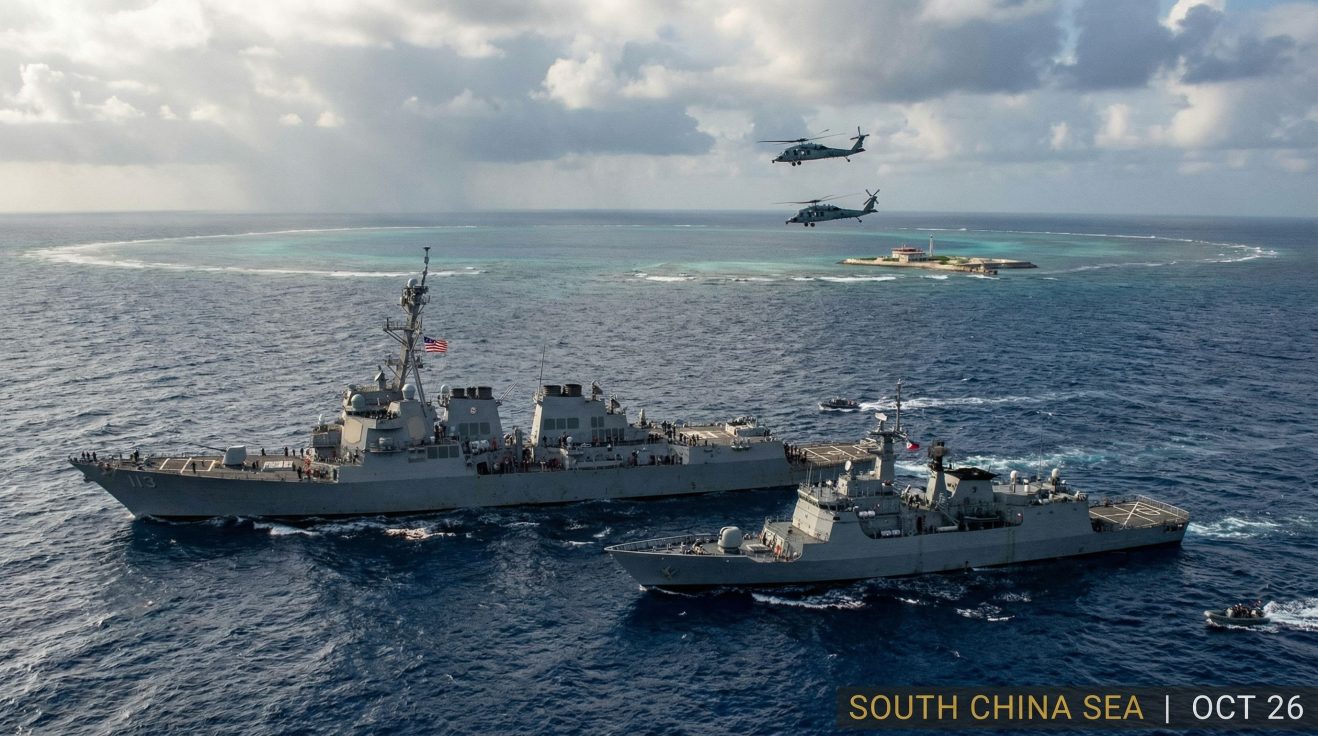
On January 27, 2026, the militaries of the Philippines and the United States conducted their 11th joint drill since November 2023 at Scarborough Shoal, a contested feature in the South China Sea that lies within the Philippines’ exclusive economic zone but is also claimed by China. The exercise showcased the Philippines’ frigate Antonio Luna, a coast guard offshore patrol vessel, two military planes, and a helicopter, alongside the USS John Finn, an Arleigh Burke-class guided missile destroyer that had transited the Taiwan Strait just two weeks earlier, and an MH-60R Seahawk helicopter from the US Indo-Pacific Command.
The Philippine armed forces emphasized that the successful conduct of these activities “enhanced coordination, tactical proficiency, and mutual understanding between allied forces,” underscoring the operational benefits of increased military cooperation between the treaty allies. However, China’s response was swift and unequivocal, with the Southern Theater Command of the Chinese military announcing that it had conducted a routine patrol in the South China Sea from January 26 to 27, without specifying the exact location but clearly signaling Beijing’s determination to monitor and counter American and Philippine military activities in waters it claims as sovereign territory.
The Chinese military statement accused the Philippines of co-opting “countries outside the region to organise the so-called ‘joint patrols’, disrupting peace and stability in the South China Sea,” and vowed that “the theatre command forces will resolutely safeguard national territorial sovereignty and maritime rights and interests, and firmly uphold regional peace and stability.” This rhetoric reflects China’s consistent position that external powers—particularly the United States—have no legitimate role in South China Sea disputes and that their involvement only complicates efforts to manage tensions through bilateral negotiations between China and individual Southeast Asian claimants.
The intensification of US-Philippine military cooperation under President Ferdinand Marcos Jr. represents a dramatic shift in Manila’s strategic orientation compared to the previous administration of Rodrigo Duterte, who had sought to downplay territorial disputes with China in favor of economic engagement and infrastructure investment. Marcos has pivoted the Philippines decisively closer to Washington in response to China’s growing military presence in the South China Sea, including the construction and militarization of artificial islands, increasingly assertive coast guard operations, and the use of maritime militia vessels to enforce Beijing’s expansive territorial claims.
Military engagements between the United States and the Philippines have soared under Marcos, reflecting a shared assessment that deterrence requires not just treaty commitments on paper but regular operational cooperation that demonstrates the ability and willingness of both nations to defend Philippine sovereignty against coercion. The frequency and location of these joint exercises—11 since November 2023, with the latest conducted at one of the most sensitive disputed features in the South China Sea—send a clear message to Beijing that the US-Philippine alliance is not merely symbolic but represents a credible military partnership capable of complicating any Chinese attempt to use force to resolve territorial disputes in its favor.
The strategic significance of Scarborough Shoal cannot be overstated. Located approximately 120 nautical miles west of the Philippine island of Luzon, the shoal has been effectively controlled by China since a 2012 standoff with the Philippines, during which Chinese vessels prevented Philippine ships from accessing the feature and Beijing subsequently maintained a persistent presence that has excluded Philippine fishermen from traditional fishing grounds. The 2016 arbitral tribunal ruling under the United Nations Convention on the Law of the Sea (UNCLOS) found that China’s claims to historic rights over the waters of the South China Sea had no legal basis and that Scarborough Shoal lies within the Philippines’ exclusive economic zone, but Beijing rejected the ruling as “null and void” and has continued to assert control over the feature.
By conducting joint exercises at Scarborough Shoal, the United States and the Philippines are challenging China’s effective control and asserting the principle that freedom of navigation and overflight in international waters cannot be restricted by unilateral claims that lack basis in international law. However, this approach also carries risks of escalation, as China views such activities as provocations that undermine its sovereignty and has demonstrated a willingness to use its coast guard, maritime militia, and naval forces to interfere with foreign military operations in waters it claims.
The broader context for these tensions is China’s assertion of sovereignty over nearly all the South China Sea, based on the so-called “nine-dash line” that encompasses waters and features within the exclusive economic zones of Brunei, Indonesia, Malaysia, the Philippines, and Vietnam. Beijing’s extensive maritime claims overlap with the legal rights of multiple Southeast Asian nations under UNCLOS, creating a complex web of competing jurisdictions that China seeks to resolve through bilateral negotiations from a position of strength, while claimant states and external powers like the United States insist that disputes must be managed through multilateral frameworks and in accordance with international law.
China’s strategy in the South China Sea has combined incremental expansion of control—through land reclamation, construction of military facilities, deployment of advanced weapons systems, and sustained presence operations by coast guard and maritime militia vessels—with diplomatic efforts to prevent the formation of a unified front among Southeast Asian claimants and to exclude external powers from involvement in dispute resolution. This approach has achieved considerable success in establishing facts on the ground that are difficult to reverse without the use of force, while avoiding the kind of dramatic military action that might trigger a coordinated international response.
However, China’s assertiveness has also generated a backlash that is reshaping regional security architecture in ways that may ultimately undermine Beijing’s strategic objectives. The strengthening of the US-Philippine alliance is part of a broader pattern of regional states hedging against Chinese power by deepening security cooperation with the United States and with each other, creating a more complex and potentially constraining environment for Chinese military operations.
The growing defense ties between Japan and the Philippines represent a particularly significant development in this regard, as they link the security dynamics of the East China Sea—where Japan and China have their own territorial dispute over the Senkaku/Diaoyu Islands—with those of the South China Sea. Analysts have described this as creating an emerging “two front problem” for China, in which military pressure or conflict in one theater could trigger responses in the other, complicating Beijing’s ability to concentrate forces and achieve its objectives without risking escalation on multiple fronts simultaneously.
The Association of Southeast Asian Nations (ASEAN) has expressed concern about the deteriorating security environment in the South China Sea, with member states viewing “with concern land reclamations, ‘serious incidents'” in the disputed waters, according to statements issued following recent ministerial meetings. ASEAN has committed to completing negotiations on a South China Sea Code of Conduct by the end of 2026, with Philippine Foreign Secretary Maria Theresa Lazaro telling reporters that the long-delayed agreement will be concluded this year.
However, skepticism remains about whether a Code of Conduct can effectively constrain Chinese behavior or provide meaningful protections for the rights of Southeast Asian claimants. Previous negotiating rounds have revealed deep divisions between ASEAN members about how assertive the Code should be in limiting military activities and establishing dispute resolution mechanisms, with some states reluctant to support provisions that China opposes for fear of jeopardizing their own bilateral relationships with Beijing. China, for its part, has used the negotiating process to argue that progress toward a Code of Conduct demonstrates that regional states can manage disputes without external interference, even as it continues to strengthen its military position in ways that the Code is unlikely to reverse.
The Philippines has taken an increasingly assertive stance in defending its maritime rights, not only through enhanced military cooperation with the United States but also through diplomatic protests, legal challenges, and efforts to maintain a presence at disputed features despite Chinese intimidation. Manila issued a notice in late January 2026 warning of large-scale military exercises across a wide area of the South China Sea extending through the end of March, prompting Chinese accusations that the Philippines is “stoking tensions” with provocative military activities.
This exchange reflects the fundamental disagreement between the two sides about who bears responsibility for rising tensions in the South China Sea. From the Philippine perspective, China’s construction of military facilities on disputed features, its use of coast guard and maritime militia vessels to harass Philippine ships and fishermen, and its refusal to accept the 2016 arbitral ruling represent the primary sources of instability, and Philippine efforts to defend its sovereignty and maintain access to its own exclusive economic zone are legitimate responses to Chinese aggression. From China’s perspective, the Philippines’ alignment with the United States and its conduct of military exercises in disputed waters represent provocations designed to internationalize what Beijing insists should be resolved through bilateral negotiations, and Chinese defensive measures are necessary responses to external interference in its internal affairs.
The Philippines has also sought to manage tensions through diplomatic channels, with Manila and Beijing resuming bilateral political dialogue on January 30, 2026, after “more than a year-long hiatus,” according to the Chinese Embassy. However, this resumption of dialogue occurred against a backdrop of what the Philippines described as “alarming” escalating verbal exchanges with Chinese diplomats in Manila over the territorial dispute, suggesting that diplomatic engagement has done little to narrow the fundamental gap between the two sides’ positions.
The United States has framed its deepening military cooperation with the Philippines as part of a broader strategy to uphold a “free and open Indo-Pacific” in which all nations can exercise their rights under international law without coercion. Washington has emphasized that it takes no position on the merits of competing territorial claims in the South China Sea but opposes any attempt to resolve disputes through intimidation or force, and it has committed to supporting the Philippines under the 1951 Mutual Defense Treaty, which obligates the United States to come to the defense of Philippine forces, public vessels, or aircraft in the Pacific, including the South China Sea.
However, the precise circumstances under which the United States would intervene militarily to support the Philippines in a South China Sea contingency remain ambiguous, and this ambiguity serves both deterrent and reassurance functions. On one hand, the lack of a clear red line leaves China uncertain about whether specific actions might trigger American military involvement, potentially deterring aggressive moves that might otherwise seem to carry acceptable risks. On the other hand, the ambiguity also provides the United States with flexibility to calibrate its response based on the specific circumstances of an incident, avoiding automatic escalation to armed conflict while maintaining the credibility of its alliance commitments through regular joint exercises and public statements of support.
The deployment of advanced US naval assets to the South China Sea, including Arleigh Burke-class destroyers and carrier strike groups, demonstrates American capability to project power into waters that China considers strategically vital and where Beijing has invested heavily in anti-access/area denial capabilities designed to complicate US military operations. The USS John Finn’s recent transit of the Taiwan Strait before participating in the joint exercise with the Philippines at Scarborough Shoal sends a message that the United States will not be deterred from operating in international waters by Chinese military modernization or political objections.
China has responded to the increased US military presence by deploying its own naval forces to shadow American and Philippine vessels, as evidenced by US military photographs showing a Chinese warship monitoring the January 27 joint exercise. This pattern of close encounters between Chinese and American naval forces in the South China Sea carries inherent risks of miscalculation or accident that could escalate into a more serious confrontation, particularly if either side interprets the other’s actions as threatening or if an incident occurs that results in casualties or damage to vessels.
The South China Sea is one of the world’s most important maritime regions, with an estimated one-third of global shipping passing through its waters, connecting the Indian and Pacific Oceans and linking the economies of East Asia with markets in Europe, the Middle East, and Africa. The region also contains significant fisheries that provide livelihoods for millions of people in Southeast Asian coastal communities, as well as potential hydrocarbon resources that remain largely unexplored due to the unresolved territorial disputes. Any disruption to freedom of navigation in the South China Sea would have severe economic consequences far beyond the immediate region, affecting global supply chains and energy markets.
The strategic competition in the South China Sea is not merely about control of specific features or waters but reflects broader questions about the future of the regional and global order. China’s approach challenges the principle that international law, rather than power, should govern relations between states and determine the resolution of disputes, and Beijing’s success or failure in establishing control over the South China Sea will have implications for other territorial disputes and for the credibility of international legal frameworks more broadly.
For the United States, the South China Sea represents a test of its commitment to upholding the rules-based international order and supporting allies and partners against coercion. Failure to effectively counter Chinese assertiveness in the South China Sea could undermine confidence in American security guarantees throughout the Indo-Pacific and beyond, potentially encouraging other revisionist powers to challenge existing territorial arrangements and international norms. However, an overly confrontational approach that leads to military conflict with China would carry catastrophic risks for all parties and for the global economy.
The challenge for policymakers in Washington, Manila, and other regional capitals is to develop strategies that effectively defend legitimate rights and interests, deter aggression, and uphold international law, while managing the risks of escalation and maintaining channels for diplomatic engagement that could eventually lead to more stable arrangements. The intensification of US-Philippine military cooperation represents one element of such a strategy, demonstrating resolve and capability while stopping short of actions that would make conflict inevitable.
Looking ahead, the trajectory of South China Sea tensions will depend on several key factors: whether China continues to expand its military presence and assertiveness or moderates its approach in response to regional pushback; whether ASEAN can maintain sufficient unity to effectively engage with China on a Code of Conduct and other confidence-building measures; whether the United States sustains its commitment to the region despite competing global priorities; and whether all parties can develop mechanisms for crisis management and de-escalation that reduce the risks of miscalculation.
The stakes are high, not only for the nations directly involved in territorial disputes but for the broader international community that depends on peace and stability in the Indo-Pacific. The South China Sea will remain a critical arena where competing visions of regional order are tested, and where the decisions made by leaders in Beijing, Washington, Manila, and other capitals will shape the security environment for decades to come.