
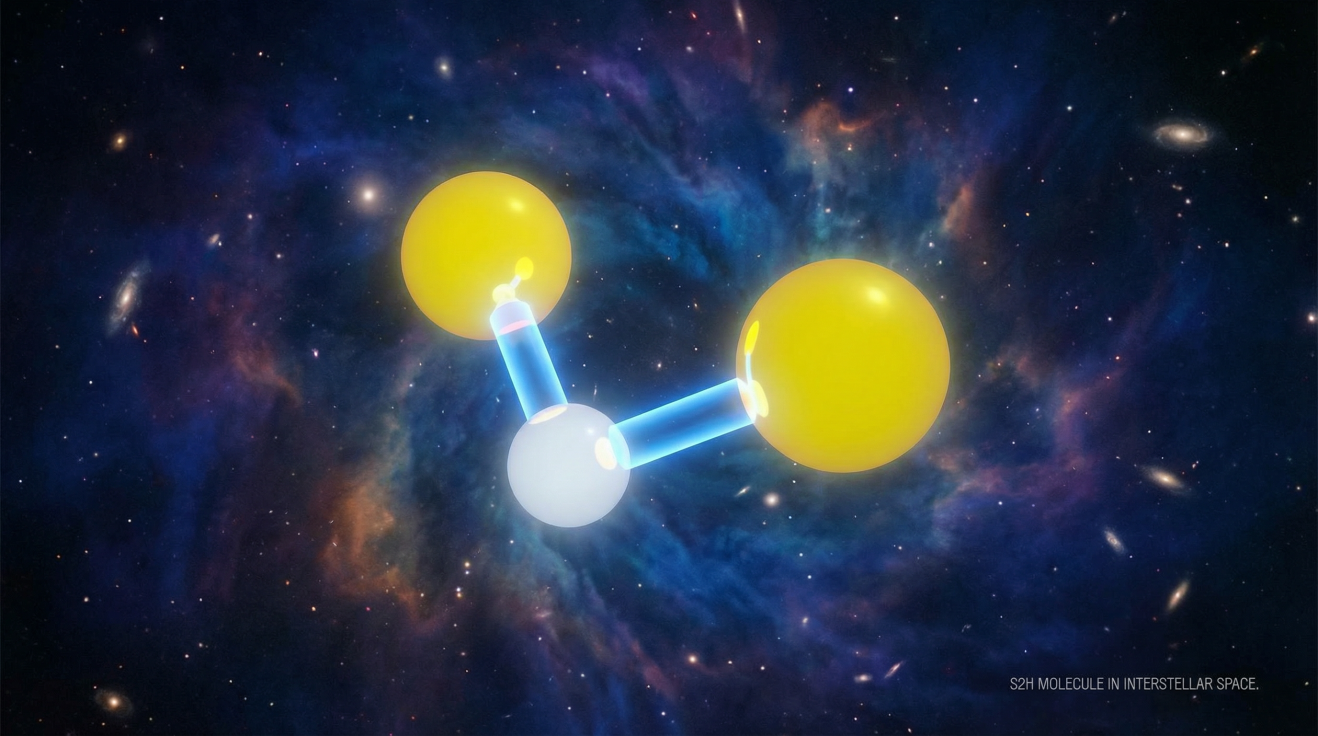
Astronomers have detected the largest sulfur-containing molecule ever found in interstellar space, marking a significant breakthrough in understanding how complex organic molecules form in the cosmos and potentially shedding light on the origins of life itself.
The discovery of 1-cyanonaphth alene, announced January 30, 2026, represents a major milestone in astrochemistry. This complex aromatic molecule contains sulfur, carbon, hydrogen, and nitrogen—key building blocks of biological molecules.
The Discovery
Using advanced radio telescopes, an international team of astronomers detected the molecular signature of 1-cyanonapthalene in the Taurus Molecular Cloud, a star-forming region located approximately 450 light-years from Earth.
“This is the most complex sulfur-bearing molecule we’ve ever found in space,” said Dr. Maria Chen, lead astronomer at the European Southern Observatory. “Its presence suggests that the chemical pathways leading to life’s building blocks are more common in the universe than we previously thought.”
Why Sulfur Matters
Sulfur plays a crucial role in biochemistry on Earth. It’s found in amino acids like cysteine and methionine, which are essential components of proteins. Sulfur-containing molecules also participate in energy transfer processes within cells.
Despite its biological importance, astronomers have long struggled to account for sulfur in interstellar chemistry. Much of the sulfur expected in molecular clouds has been “missing”—neither detected in gas form nor locked in dust grains.
“Finding large sulfur-bearing molecules like this helps solve the sulfur depletion problem,” explained Dr. James Rodriguez, astrochemist at MIT. “It shows that sulfur is being incorporated into complex organic molecules in space, which we couldn’t detect until now.”
Implications for the Origin of Life
The discovery has profound implications for theories about how life began. Complex organic molecules formed in space can be delivered to planets via comets and meteorites, potentially seeding worlds with the chemical precursors necessary for life.
“Every complex molecule we find in space expands the inventory of organic compounds available for planet formation,” noted Dr. Sarah Williams, NASA astrobiologist. “This sulfur-containing molecule could have been present in the early solar system and may have contributed to the chemistry that led to life on Earth.”
The molecule’s aromatic structure—featuring interconnected carbon rings—makes it particularly stable and resistant to destruction by ultraviolet radiation. This stability would allow it to survive the harsh conditions of space and potentially reach planetary surfaces intact.
How It Forms
Researchers believe 1-cyanonapthalene forms through a series of chemical reactions on the surfaces of interstellar dust grains. At temperatures just above absolute zero, atoms and simple molecules can stick to dust particles and gradually build up into more complex structures.
“The dust grains act like tiny chemical factories,” said Dr. Chen. “They provide a surface where molecules can meet and react, protected from the destructive radiation that would break them apart in open space.”
The specific pathways that produce sulfur-bearing aromatic molecules remain under investigation, but the discovery confirms that such processes occur naturally in star-forming regions throughout the galaxy.
Detection Challenges
Finding complex molecules in space requires sophisticated radio astronomy techniques. Each molecule has a unique spectral fingerprint—specific frequencies of light it absorbs or emits based on its structure.
The research team used the Atacama Large Millimeter/submillimeter Array (ALMA) in Chile, one of the world’s most powerful radio telescope facilities, to detect the faint signals from 1-cyanonapthalene molecules in the Taurus cloud.
“We had to observe for hundreds of hours to collect enough signal,” explained Dr. Rodriguez. “These molecules exist in very low concentrations, so detecting them pushes our instruments to their limits.”
Future Research
The discovery opens new avenues for astrochemical research. Scientists plan to search for even larger sulfur-containing molecules and to study how these compounds evolve as molecular clouds collapse to form new stars and planetary systems.
“We want to trace the journey of sulfur from simple atoms to complex molecules to planetary surfaces,” said Dr. Williams. “Understanding this pathway will help us predict which exoplanets might have the right chemistry for life.”
The James Webb Space Telescope, with its infrared capabilities, may be able to detect additional complex organic molecules in star-forming regions, complementing radio telescope observations.
Broader Context
This discovery is part of a growing body of evidence that complex organic chemistry is widespread in the universe. In recent years, astronomers have detected amino acids, sugars, and even the building blocks of DNA in meteorites and cometary samples.
“The universe is a giant chemistry lab,” noted Dr. Chen. “Wherever we look, we find organic molecules becoming more complex. This suggests that the chemical foundations for life are common, even if life itself may be rare.”
The research was published in the Astrophysical Journal and involved collaborators from institutions across Europe, North America, and Asia. The findings represent years of observational work and data analysis.
As telescopes become more sensitive and computational techniques improve, scientists expect to discover an even richer inventory of complex molecules in space, each one providing clues about the cosmic origins of the chemistry that makes life possible.