Tariff Mechanism Targets Cuba’s Energy Lifeline
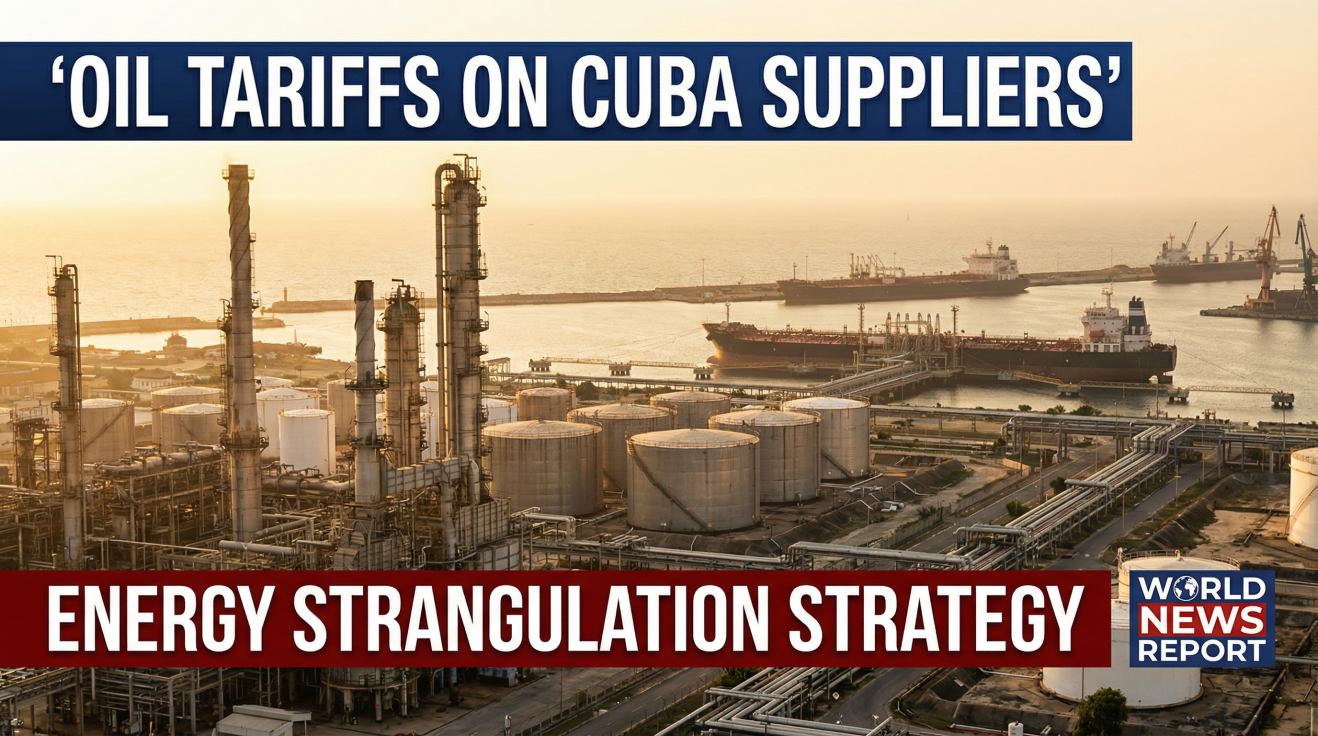
President Trump’s executive order on Cuba establishes an unprecedented tariff system designed to cut off the island’s oil supply by punishing any country that provides energy to the communist regime. The order authorizes additional tariffs on imports from any country that “directly or indirectly sells or otherwise provides any oil to Cuba,” creating a mechanism to force third-party nations to choose between trading with Cuba or maintaining access to the American market.
The tariff mechanism represents economic warfare targeting Cuba’s most critical vulnerability—its dependence on imported oil to power its aging infrastructure and maintain basic services. With Venezuela’s oil shipments drastically reduced and Cuba facing severe energy shortages, the administration’s strategy aims to eliminate alternative suppliers by making it economically painful for any country to sell oil to Havana.
“I think Cuba will not be able to survive,” Trump stated when announcing the order, making explicit the administration’s goal of using energy strangulation to force regime change. The policy tests whether U.S. market access provides sufficient leverage to compel countries worldwide to comply with American foreign policy objectives.
Multi-Agency Implementation Process
The executive order establishes a complex bureaucratic process for identifying countries that supply oil to Cuba and determining appropriate tariff levels. The Secretary of Commerce, in consultation with the Secretary of State, will determine whether foreign countries are selling or providing oil to Cuba after the order’s effective date.
Once the Commerce Secretary makes an affirmative finding, the Secretary of State—in consultation with the Treasury Secretary, Commerce Secretary, Homeland Security Secretary, and U.S. Trade Representative—will determine whether and to what extent additional tariffs should be imposed on goods from the offending country. The President retains final authority to impose tariffs based on these recommendations.
This bureaucratic structure creates a flexible enforcement mechanism that allows the administration to calibrate economic pressure based on geopolitical considerations rather than applying blanket tariffs automatically. Countries with strategic importance to the United States may face lighter penalties than those with limited bilateral trade or diplomatic ties, creating incentives for cooperation while maintaining pressure on Cuba’s potential suppliers.
The order does not specify tariff rates, leaving that determination to the interagency process and presidential discretion. This ambiguity creates uncertainty for countries currently supplying oil to Cuba, potentially deterring continued shipments even before formal tariffs are imposed. The threat of undefined economic consequences may prove as effective as actual tariff implementation in cutting off Cuba’s energy supply.
Cuba’s Energy Crisis Context
The tariff mechanism targets Cuba at a moment of profound energy vulnerability. The island has experienced widespread blackouts, fuel rationing, and economic disruption as its aging power infrastructure fails and oil supplies dwindle. Cuba’s electricity grid, built largely during the Soviet era, requires constant maintenance and imported fuel to function—resources that have become increasingly scarce.
Venezuela, historically Cuba’s primary oil supplier, has drastically reduced shipments as its own oil industry collapsed under mismanagement and U.S. sanctions. During the height of the Venezuela-Cuba alliance, Caracas provided up to 100,000 barrels per day of subsidized oil to Havana. Those shipments have fallen to a fraction of historical levels, leaving Cuba scrambling for alternative suppliers.
Cuba’s energy crisis has triggered social unrest, with protests erupting in multiple cities as residents endure prolonged power outages in tropical heat. The communist government has struggled to maintain basic services, implementing rolling blackouts and fuel rationing that have paralyzed economic activity and intensified public frustration with the regime.
The Trump administration’s tariff threat aims to eliminate the alternative suppliers Cuba has turned to in Venezuela’s absence, betting that the regime cannot survive without external energy support and that no country will risk U.S. tariffs to keep Cuba supplied. If successful, the policy could leave Cuba in complete darkness, potentially triggering regime collapse or forcing Havana to negotiate with Washington on U.S. terms.
Potential Target Countries
Several countries have provided limited oil assistance to Cuba in recent years, making them potential targets for the tariff mechanism. Mexico, under previous administrations, has sold small quantities of oil to Cuba on commercial terms, though current Mexican policy toward Cuba energy assistance remains unclear. Mexico’s massive trade relationship with the United States—over $600 billion annually—creates powerful incentives to avoid U.S. tariffs.
Russia has periodically provided oil and technical assistance to Cuba, viewing the island as a strategic foothold in the Western Hemisphere. Russian oil companies have explored opportunities in Cuba’s offshore fields, though production has remained limited due to technical challenges and lack of investment. Russia’s willingness to absorb U.S. tariffs to support Cuba will test Moscow’s commitment to maintaining influence in the Caribbean.
China, Cuba’s largest trading partner, has not historically been a major oil supplier to the island but has the capacity to provide energy assistance if it chooses to do so. China’s extensive trade relationship with the United States—hundreds of billions of dollars in annual bilateral commerce—makes it vulnerable to tariff threats, though Beijing has demonstrated willingness to absorb economic costs when strategic interests are at stake.
Smaller countries including Algeria, Angola, and other oil producers have occasionally sold oil to Cuba on commercial terms. These countries face a stark choice: continue limited oil sales to Cuba and risk losing access to the much larger U.S. market, or comply with American pressure and abandon Cuba to energy starvation.
Economic Leverage and Market Access
The tariff mechanism weaponizes U.S. market access, forcing countries to choose between trading with Cuba or trading with the United States—a choice that for most countries is economically obvious. The U.S. economy remains the world’s largest consumer market, and access to American consumers represents a critical component of export-oriented growth strategies for countries worldwide.
By threatening tariffs on all imports from countries that supply oil to Cuba, the executive order creates asymmetric leverage that reflects the vast disparity between Cuba’s economic insignificance and America’s market power. For most countries, the economic value of selling oil to Cuba pales in comparison to the potential costs of losing preferential access to the U.S. market.
The policy tests the limits of economic coercion in an increasingly multipolar world where countries have alternatives to U.S.-dominated trade and financial systems. China’s Belt and Road Initiative and efforts to create sanctions-resistant payment systems provide potential mechanisms for countries to reduce dependence on U.S. market access, though these alternatives remain incomplete and less attractive than direct access to American consumers.
The tariff mechanism also raises questions about the sustainability of using market access as a foreign policy tool. If the United States routinely threatens tariffs to achieve policy objectives unrelated to trade, countries may accelerate efforts to diversify their export markets and reduce vulnerability to American economic pressure. The long-term effectiveness of this strategy depends on maintaining U.S. economic dominance and the absence of viable alternatives.
Legal and Trade Policy Implications
The executive order’s tariff mechanism operates under emergency powers granted by the International Emergency Economic Powers Act (IEEPA), which provides the President with broad authority to regulate international commerce during declared national emergencies. The invocation of IEEPA allows the administration to impose tariffs without the normal trade policy processes that would require congressional involvement and compliance with World Trade Organization rules.
Trade policy experts question whether the tariff mechanism complies with U.S. obligations under international trade agreements. The World Trade Organization generally prohibits discriminatory tariffs that target specific countries based on their trade relationships with third parties. However, WTO rules include national security exceptions that may provide legal cover for the Cuba tariff mechanism, though such exceptions are subject to dispute resolution processes.
The policy also raises concerns about precedent-setting for future administrations. If emergency powers can be invoked to impose tariffs based on third-party trade relationships, what limits exist on presidential authority to use economic coercion for foreign policy objectives? Legal scholars worry that expansive interpretations of emergency authority could undermine the constitutional balance between executive and legislative powers in trade policy.
Geopolitical Calculations
The tariff mechanism’s effectiveness depends on complex geopolitical calculations by potential Cuba oil suppliers. Countries must weigh the economic costs of U.S. tariffs against the strategic benefits of supporting Cuba, the political costs of appearing to bow to American pressure, and the precedent set by compliance or defiance.
For Russia, supporting Cuba despite U.S. tariffs would demonstrate Moscow’s willingness to challenge American economic dominance and maintain strategic positions in the Western Hemisphere. However, Russia’s economy is already strained by sanctions related to Ukraine and other conflicts, making additional U.S. tariffs economically painful even if strategically desirable.
China faces similar calculations but with higher economic stakes. Beijing’s trade surplus with the United States provides significant economic benefits that would be jeopardized by tariffs, but abandoning Cuba to U.S. pressure could undermine China’s credibility as an alternative to American leadership. China’s response to the tariff mechanism will signal how aggressively Beijing is willing to challenge U.S. economic leverage in pursuit of geopolitical objectives.
Smaller countries lack the economic and political resources to resist U.S. pressure, making them likely to comply with the tariff mechanism regardless of their views on Cuba policy. This asymmetry means that Cuba’s ability to secure alternative oil supplies depends almost entirely on whether major powers like Russia and China are willing to absorb economic costs to support the island.
Implementation Timeline and Uncertainty
The executive order does not specify when the tariff mechanism will begin operating or how quickly the administration will identify and penalize countries supplying oil to Cuba. This timeline uncertainty creates immediate deterrent effects, as potential suppliers must consider the risk of retroactive tariffs on shipments made after the order’s effective date.
The multi-agency process for determining tariff levels could take weeks or months, during which time countries must decide whether to continue oil shipments to Cuba or preemptively halt sales to avoid potential penalties. This decision-making under uncertainty favors U.S. objectives by creating strong incentives for risk-averse behavior among potential Cuba oil suppliers.
The administration’s discretion in imposing tariffs also creates opportunities for diplomatic negotiations. Countries that halt oil shipments to Cuba may receive assurances that they will not face tariffs, while those that continue supplies may face escalating economic pressure. This flexibility allows the administration to use the tariff mechanism as a negotiating tool rather than merely a punitive measure.
Cuba’s Response Options
Cuba has limited options for responding to the tariff mechanism beyond seeking support from countries willing to defy U.S. pressure. The island cannot retaliate economically against the United States given the vast disparity in economic power, and military responses are not credible given U.S. military superiority and Cuba’s geographic vulnerability.
Havana’s most viable strategy involves appealing to international opinion and portraying the tariff mechanism as illegal economic warfare that violates international law and humanitarian principles. Cuba has decades of experience using international forums to criticize U.S. sanctions, and the tariff mechanism provides fresh evidence for arguments about American unilateralism and economic coercion.
Cuba may also attempt to reduce its energy vulnerability by accelerating renewable energy development, though the island lacks the financial resources and technical capacity to rapidly transform its energy infrastructure. Solar, wind, and other renewable sources could eventually reduce Cuba’s dependence on imported oil, but such transitions require years of investment that Cuba cannot currently afford.
In the short term, Cuba’s survival depends on whether Russia, China, or other countries are willing to provide oil despite U.S. tariff threats—a calculation that will determine whether the Trump administration’s economic warfare strategy succeeds in forcing regime change.
Humanitarian Concerns
Critics of the tariff mechanism argue that cutting off Cuba’s oil supply constitutes collective punishment that will harm ordinary Cubans far more than the regime. Without reliable electricity, hospitals cannot function, food spoils, and basic services collapse—consequences that fall most heavily on vulnerable populations rather than government officials.
Human rights organizations have expressed concern that the tariff mechanism violates humanitarian principles by deliberately targeting civilian infrastructure and essential services. International humanitarian law generally prohibits actions that predictably cause severe civilian suffering, though the legal status of economic sanctions under these principles remains contested.
The Trump administration counters that the Cuban regime bears responsibility for any humanitarian consequences of U.S. policy, arguing that the government could avoid suffering by implementing democratic reforms and ending relationships with adversarial powers. This position places the onus on Havana to change its behavior rather than on Washington to moderate its economic pressure.
Looking Ahead
The tariff mechanism’s implementation will unfold over the coming months as the administration identifies countries supplying oil to Cuba and determines appropriate penalty levels. The policy’s success depends on whether the threat of U.S. tariffs proves sufficient to deter potential suppliers or whether major powers like Russia and China are willing to absorb economic costs to support Cuba.
If the mechanism succeeds in cutting off Cuba’s oil supply, the island faces a humanitarian and political crisis that could destabilize the regime. If it fails because countries continue supplying oil despite tariff threats, the administration will face difficult choices about escalation and the credibility of its economic coercion strategy.
Beyond immediate implementation, the tariff mechanism raises fundamental questions about the future of U.S. economic statecraft and the sustainability of using market access as a foreign policy weapon. The Cuba case will provide lessons about the limits of economic coercion in a multipolar world where alternatives to U.S.-dominated systems are gradually emerging.