Diplomatic Reset After Military Intervention
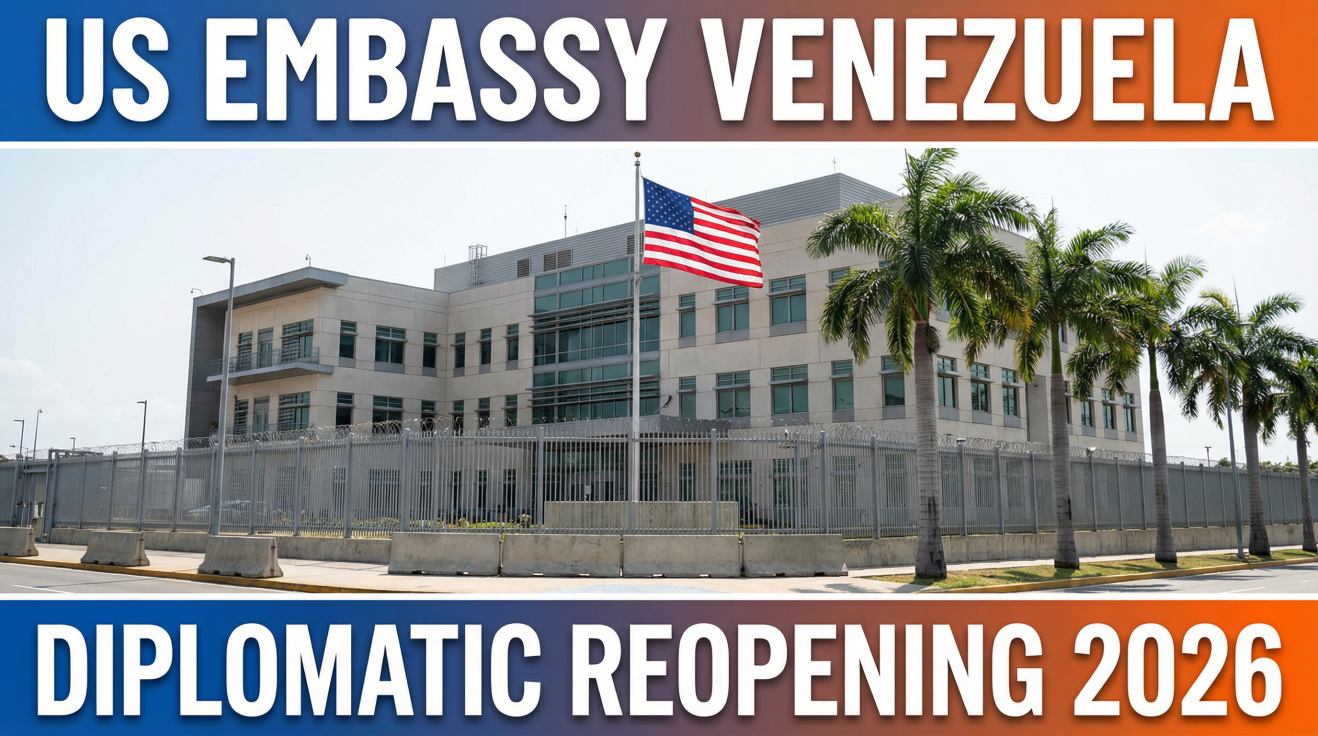
The Trump administration has formally notified Congress of its intent to reopen the United States Embassy in Caracas, marking the first concrete step toward restoring diplomatic relations with Venezuela since the embassy’s closure in March 2019. The move follows the January 3 U.S. military operation that captured then-President Nicolás Maduro, fundamentally altering the geopolitical landscape of U.S.-Venezuela relations.
In identical letters dated January 27 to ten House and Senate committees, the State Department outlined a phased approach to potentially resuming embassy operations. The notification represents the administration’s most significant diplomatic initiative since Maduro’s ouster, signaling a strategic pivot from isolation to engagement with Venezuela’s acting government under Delcy Rodríguez.
Secretary of State Marco Rubio is scheduled to testify before the Senate Foreign Relations Committee on January 29 regarding Venezuela policy, with the embassy reopening expected to feature prominently in discussions about the administration’s broader Latin America strategy. The timing of the congressional notification—just two days before Rubio’s testimony—underscores the administration’s determination to move quickly on normalization.
Phased Approach to Embassy Operations
The State Department’s notification details a methodical, multi-phase process for restoring embassy functions. The initial phase involves deploying temporary staff to conduct “select” diplomatic functions while the existing embassy compound undergoes necessary upgrades to meet current security and operational standards.
“We are writing to notify the committee of the Department of State’s intent to implement a phased approach to potentially resume Embassy Caracas operations,” the department stated in its congressional notification. The temporary staffers will live and work in an interim facility while the main embassy compound is brought up to standard—a process that could take months given the building’s seven-year closure.
The first phase prioritizes security and management functions, with plans to gradually expand operations to include consular services, political and economic reporting, and public diplomacy as conditions allow. This cautious approach reflects lessons learned from hasty diplomatic reopenings in other countries where security concerns were inadequately addressed.
The Venezuela Affairs Unit, currently operating from the U.S. Embassy in Bogota, Colombia, will eventually relocate to Caracas once the phased reopening reaches sufficient maturity. This unit has maintained limited diplomatic engagement with Venezuelan matters since 2019, primarily processing visas and providing emergency services to American citizens through the Colombian facility.
Diplomatic Complexities and Recognition Issues
Reopening the embassy requires navigating complex diplomatic and legal terrain. The United States has recognized the Venezuelan National Assembly elected in 2015 as the country’s legitimate government since 2019, a position that would need to be formally revoked to establish full diplomatic relations with Rodríguez’s acting government.
This recognition issue has created a diplomatic impasse for years, with the U.S. maintaining that Maduro’s 2018 reelection was fraudulent and therefore illegitimate. The military operation that removed Maduro has eliminated the practical basis for this position, but the legal and diplomatic mechanisms for transferring recognition remain politically sensitive.
Acting President Delcy Rodríguez addressed the diplomatic thaw in televised remarks on January 28, stating that her government and the Trump administration “have established respectful and courteous channels of communication” since Maduro’s capture. While she did not specifically address the embassy reopening, Rodríguez indicated she is working with President Trump and Secretary Rubio to set “a working agenda” for bilateral relations.
The establishment of direct communication channels between Washington and Caracas represents a dramatic shift from the hostile rhetoric and mutual isolation that characterized U.S.-Venezuela relations throughout Maduro’s tenure. Venezuelan officials have signaled openness to cooperation on issues ranging from migration to counternarcotics, areas where U.S. and Venezuelan interests align despite broader ideological differences.
Initial Survey and Diplomatic Appointments
Shortly after Maduro’s removal, a small team from the Venezuela Affairs Unit traveled to Caracas to conduct an initial survey of the shuttered embassy compound. The assessment focused on security vulnerabilities, infrastructure degradation, and operational requirements for reopening—critical information for planning the phased restoration of embassy functions.
The State Department has already named a Bogota-based career diplomat to serve as charge d’affaires for Venezuela, a key appointment that signals the administration’s commitment to professional diplomatic engagement rather than political appointees. The charge d’affaires will oversee the phased reopening and serve as the senior U.S. diplomat in Venezuela until an ambassador is nominated and confirmed.
The congressional notification indicates that temporary duty personnel will perform limited functions initially, including security assessments, facility management, and basic consular services. As the embassy compound is upgraded and security protocols established, operations will expand to include political reporting, economic analysis, and public diplomacy—the full range of embassy functions.
Broader Context: Venezuela After Maduro
The embassy reopening unfolds against the backdrop of Venezuela’s uncertain political transition. Maduro’s capture eliminated the authoritarian strongman who dominated Venezuelan politics for over a decade, but the country faces profound challenges including economic collapse, humanitarian crisis, and institutional decay.
The Trump administration has moved cautiously in its dealings with Rodríguez’s acting government, balancing the desire for normalized relations against concerns about Venezuela’s democratic trajectory and human rights record. The phased embassy reopening reflects this cautious optimism—establishing a diplomatic presence while maintaining flexibility to adjust course if conditions deteriorate.
President Trump announced on January 29 that he has instructed U.S. officials to reopen Venezuelan airspace for commercial travel, a significant economic gesture that complements the diplomatic reopening. The airspace decision could restore direct flights between the United States and Venezuela, facilitating business travel, family connections, and tourism that have been severed since 2019.
The combination of embassy reopening and airspace restoration signals the administration’s intent to pursue comprehensive normalization of U.S.-Venezuela relations, contingent on continued cooperation from Caracas. However, significant obstacles remain, including Venezuela’s relationships with Russia, China, and Iran—partnerships that have concerned U.S. policymakers for years.
Congressional Response and Oversight
The State Department’s notification to Congress triggers a period of congressional oversight and potential objections. While the administration has broad authority to conduct foreign policy, lawmakers from both parties have expressed concerns about rushing into normalized relations with Venezuela without adequate human rights commitments and democratic reforms.
Senator Marco Rubio’s testimony before the Senate Foreign Relations Committee will provide the first public forum for administration officials to address these concerns and outline the conditions under which full diplomatic relations would be restored. Rubio, a longtime critic of Maduro’s regime, has signaled support for engagement with Venezuela’s post-Maduro government while emphasizing the need for accountability and reform.
The phased approach outlined in the congressional notification appears designed to address these concerns by establishing a gradual process that can be halted or reversed if Venezuela fails to meet U.S. expectations. This flexibility may help secure congressional support for the broader normalization agenda.
Regional Implications
The U.S. embassy reopening carries significant implications for regional dynamics in Latin America. Venezuela’s isolation under Maduro created a diplomatic vacuum that Russia, China, and Cuba filled with economic and military support. Restoring U.S.-Venezuela relations could shift this balance, potentially reducing external influence in Caracas.
Neighboring countries including Colombia, Brazil, and Guyana have watched Venezuela’s political crisis with concern, worried about migration flows, drug trafficking, and regional instability. A U.S. diplomatic presence in Caracas could facilitate regional cooperation on these shared challenges and support Venezuela’s eventual reintegration into hemispheric institutions.
The Organization of American States (OAS), which suspended Venezuela in 2017, will face pressure to reconsider Venezuela’s status as diplomatic normalization progresses. The United States has historically played a leading role in OAS deliberations, and a restored U.S. embassy in Caracas would strengthen the case for Venezuela’s eventual readmission to regional bodies.
Economic Dimensions
Beyond diplomatic symbolism, the embassy reopening has practical economic implications. Venezuela possesses the world’s largest proven oil reserves, and U.S. oil companies historically maintained significant operations in the country before sanctions and nationalization drove them out. Restored diplomatic relations could pave the way for renewed American investment in Venezuela’s energy sector.
The Trump administration has indicated interest in supporting Venezuela’s economic recovery as part of a broader strategy to counter Chinese and Russian influence in the Western Hemisphere. A functioning U.S. embassy would facilitate commercial diplomacy, investment promotion, and economic policy coordination—activities that have been impossible during the seven-year diplomatic freeze.
However, significant obstacles remain before large-scale U.S. investment can resume. Venezuela’s economy is in ruins after years of mismanagement, corruption, and sanctions. Hyperinflation, currency collapse, and infrastructure decay have created an environment where even basic business operations are challenging. The embassy’s economic section will play a crucial role in assessing conditions and advising U.S. companies on opportunities and risks.
Security Considerations
The State Department’s emphasis on security in the initial phase of embassy reopening reflects hard-learned lessons from diplomatic facilities in high-risk environments. Venezuela’s security situation remains precarious, with armed groups, criminal organizations, and political factions competing for influence in Maduro’s absence.
The temporary facility mentioned in the congressional notification will likely serve as a secure forward operating base while the main embassy compound undergoes comprehensive security upgrades. These upgrades will include physical barriers, surveillance systems, and secure communications infrastructure designed to protect personnel and classified information.
The phased approach allows the State Department to assess the security environment in real-time and adjust staffing levels based on threat assessments, a flexibility that would not exist if the embassy reopened at full capacity immediately. This cautious methodology prioritizes personnel safety while maintaining diplomatic momentum.
Looking Ahead
The path from congressional notification to fully operational embassy will take months, if not years. Each phase of the reopening process will be evaluated against security, political, and operational benchmarks before proceeding to the next stage. The State Department has not provided a specific timeline, acknowledging that conditions in Venezuela remain fluid.
For American citizens in Venezuela, the embassy reopening offers hope for restored consular services including passport renewals, emergency assistance, and visa processing for Venezuelan family members. These services have been unavailable or severely limited since 2019, forcing Americans to travel to third countries for routine consular needs.
The broader question is whether the embassy reopening represents a genuine turning point in U.S.-Venezuela relations or merely a tactical adjustment in response to Maduro’s removal. The answer will depend on Venezuela’s political trajectory, the acting government’s willingness to implement reforms, and the Trump administration’s commitment to sustained engagement beyond the initial diplomatic gestures.
What is clear is that the United States has decided that isolation is no longer the optimal strategy for advancing American interests in Venezuela. Whether engagement proves more effective remains to be seen, but the embassy reopening marks an unmistakable shift in U.S. policy after seven years of diplomatic estrangement.